The New VS: What Micro-Companies Need to Know
The new EU Voluntary Standard introduces major simplifications for companies with 10 employees or fewer. Here is what the changes mean in practice, and why voluntary sustainability reporting can still create a competitive advantage.

Sustainability reporting in the EU is changing again, and for the smallest companies, the change is significant. On 3 July 2026, the European Commission adopted a new Voluntary Sustainability Reporting Standard (VS). The standard is currently going through scrutiny by the European Parliament and the Council and is expected to become legally effective later in 2026, following publication in the Official Journal of the European Union. Its new value chain cap provisions will apply to financial years beginning on or after 1 January 2027. Until the new standard enters into force, the VSME remains the current reference framework for voluntary sustainability reporting by SMEs.
For companies with 10 employees or fewer, the new standard introduces a substantial simplification. Several environmental datapoints that are normally expected when applying the standard will become voluntary for this group. This means that many of the EU's smallest businesses will be able to produce a sustainability report without calculating information such as their greenhouse gas emissions, energy consumption, water use or waste figures. However, this does not necessarily make sustainability reporting less valuable. For companies that already perform well on sustainability, voluntarily reporting more than the standard expects may actually become a stronger way to stand out from competitors.
From the VSME to the new Voluntary Standard
The story begins in December 2024, when EFRAG delivered the final Voluntary Sustainability Reporting Standard for non-listed SMEs, or VSME Standard, to the European Commission. The VSME was created to give smaller businesses a simpler and more proportionate way of communicating sustainability information. One of its main purposes was to help SMEs respond to the growing number of sustainability questions coming from larger customers, banks, investors and other business partners. In July 2025, the European Commission formally endorsed the VSME through a Recommendation.
The new Voluntary Standard builds on the VSME, but it is not simply a new name for the same document. The VSME provided the original reporting framework, while the new VS gives that framework a more formal role within the EU's sustainability reporting system. It also expands the scope beyond the traditional SME definition by covering undertakings with up to 1,000 employees. Importantly, the new standard is also connected to the rules that determine how much sustainability information larger companies reporting under the CSRD may request from smaller companies in their value chains.
Put simply, the VSME created the foundation, while the new Voluntary Standard builds that foundation into the EU's revised sustainability reporting framework.
What actually changes for the smallest companies?
The most significant simplification applies to companies with 10 employees or fewer. Under the new VS, several environmental datapoints in the Basic Module become explicitly voluntary for these companies. This includes information on energy consumption, Scope 1 and Scope 2 greenhouse gas emissions, water withdrawal, circular economy practices, waste generation and recycling.
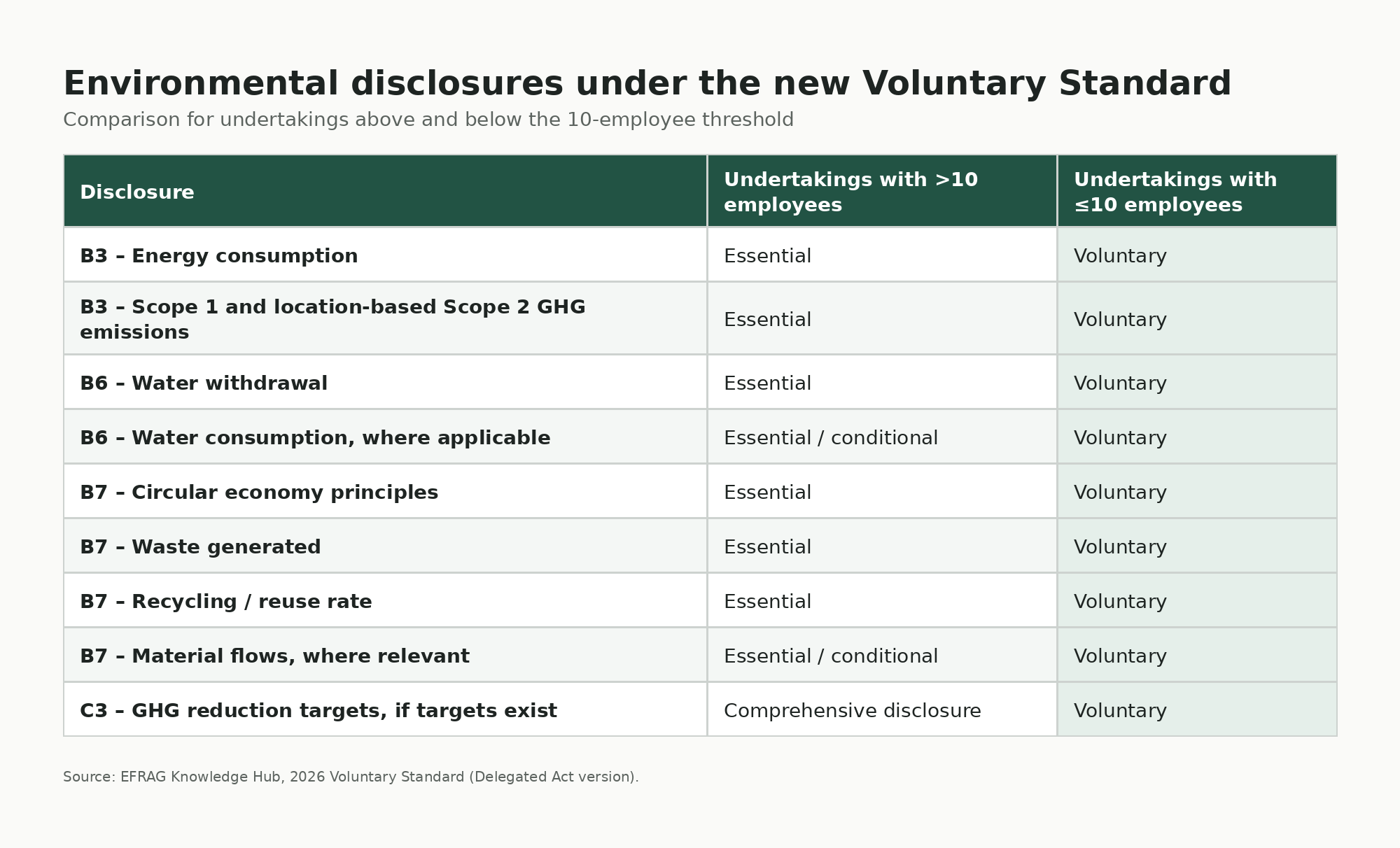
In practical terms, this could make sustainability reporting considerably easier for a small consultancy, design agency, technology company or other service-based business. A company with eight employees, for example, may be able to apply the standard without calculating its carbon footprint, collecting detailed energy data or producing figures on water and waste, unless it chooses to do so voluntarily. The simplification also extends to parts of the more detailed Comprehensive Module. Companies can still choose to provide more advanced sustainability information, but several disclosures relating to areas such as sustainability strategy, greenhouse gas reduction targets and climate risks are also voluntary for companies with 10 employees or fewer.
This does not mean that all environmental reporting disappears for every micro-company. Some disclosures depend on the company's activities or location. Pollution information may still be relevant where a company already reports pollutants to public authorities, while biodiversity information may apply if the company operates at or near a biodiversity-sensitive area. For many small service companies, however, these situations will not apply. The overall result is therefore a much lower environmental reporting burden for a large proportion of businesses with 10 employees or fewer.
The value chain cap could have an even bigger impact
Perhaps the most important change is not what small companies choose to report themselves, but what larger companies may ask them to provide.
The new VS is connected to what is known as the value chain cap. In simple terms, this sets a limit on the sustainability information that larger companies reporting under the CSRD may request from protected smaller businesses for the purpose of their own CSRD reporting. Companies with up to 1,000 employees therefore gain clearer protection against receiving sustainability information requests that go beyond what the EU framework considers proportionate.
For companies with 10 employees or fewer, that protection goes even further. The environmental datapoints covering energy consumption, greenhouse gas emissions, water withdrawal and the main waste and circular economy information are not included in their value chain cap. This could have a very practical effect. A small consultancy supplying services to a large corporation may previously have received a supplier questionnaire asking for carbon emissions, energy data, climate targets, water use and waste information. Under the new framework, there will be a much clearer limit on the information that the large company can require from that small supplier specifically for its CSRD reporting.
For the smallest businesses, this could significantly reduce the administrative burden created by increasingly detailed ESG questionnaires from customers and other value chain partners.
If less is expected, could doing more help you stand out?
This is where the change becomes particularly interesting from a business perspective. The new VS lowers the reporting expectations for the smallest companies, but it does not stop them from reporting more. A company can still calculate its greenhouse gas emissions, set reduction targets, track energy and waste, describe its sustainability strategy or provide other information that it considers useful.
For companies that already take sustainability seriously, this can create an opportunity. If many businesses with 10 employees or fewer choose to report only the minimum information, a company that voluntarily provides credible environmental data and clearly explains how it manages sustainability may become easier to distinguish from its competitors. What was previously simply part of following a reporting framework can instead become evidence that the company is managing sustainability proactively.
This can be particularly relevant in tenders and procurement processes. A customer may not need certain environmental information from a small supplier for its CSRD reporting, but that does not mean sustainability stops mattering when suppliers are compared. Larger organisations may still have their own sustainability ambitions, procurement policies and supplier evaluation criteria. When two small companies offer similar services, being able to demonstrate measured emissions, environmental targets, responsible purchasing practices or progress on resource efficiency can strengthen the overall offer.
The same logic can apply when seeking investment or financing. An investor looking at a growing small business is not only interested in what the company is legally expected to report today. They may also want to understand how well the business manages risks, how prepared it is for future growth and whether sustainability is integrated into its decision-making. A company that already collects reliable sustainability information can therefore demonstrate a level of organisation and forward planning that goes beyond the minimum expectations of the VS.
In other words, being able to say "we are not expected to report this information, but we choose to measure and manage it anyway" can send a strong signal. It shows that sustainability is being treated as part of the business rather than simply as a reporting obligation.
The change does not apply equally to every small business
It is important to distinguish companies with 10 employees or fewer from those above that threshold. The specific environmental simplifications described above apply only to the smallest undertakings. Companies with more than 10 employees do not receive the same exemption from the main environmental datapoints, even though the Voluntary Standard as a whole covers undertakings with up to 1,000 employees.
This means that a company with nine employees and a company with nineteen employees may face quite different expectations when using the same Voluntary Standard. For businesses above the 10 employee threshold, information on energy, greenhouse gas emissions, water and waste continues to have a much more central role in the reporting framework and in the value chain cap.
A lower minimum does not necessarily mean lower ambition
For companies with 10 employees or fewer, the new Voluntary Standard clearly makes sustainability reporting less burdensome. That is an important simplification, particularly for businesses with limited time and resources. But reducing the minimum reporting expectation does not automatically reduce the business value of sustainability information.
Instead, the new framework gives small companies more choice. Some businesses may reasonably decide that detailed environmental reporting offers little benefit and use the simplified standard accordingly. Others may decide that customers, investors, employees or other stakeholders care about sustainability and that reporting beyond the minimum helps them demonstrate the quality of their business.
The key question may therefore be shifting from "What sustainability information are we expected to report?" to "What sustainability information is worth reporting because it helps us win business, attract investment and build trust?"
For ambitious small companies, that distinction could make voluntary sustainability reporting more valuable, not less.
Sources: EFRAG, Voluntary Sustainability Reporting Standard for non-listed SMEs (VSME), published December 2024. // European Commission, Recommendation (EU) 2025/1710 on voluntary sustainability reporting for SMEs, adopted July 2025. // European Commission, Commission Delegated Regulation C(2026) 5011 establishing the Voluntary Sustainability Reporting Standard, adopted July 2026. // European Parliament and Council, Directive (EU) 2026/470 amending the sustainability reporting framework and introducing the value chain cap, adopted February 2026. // EFRAG Knowledge Hub, Voluntary Standard, 2026 Delegated Act version.
Keep reading

The VSME Just Got a Bigger Reach
The EU's voluntary reporting framework is expanding to companies with up to 1,000 employees. Here's what that means.

Exempt From Reporting, Not From Expectations
Companies with more than 250 employees or less than 1000 are now outside the direct scope of mandatory sustainability reporting. Still, the business case for sustainability documentation has never been stronger.

Large Companies Now Have a Place in the VSME (VS)
Companies with 250 to 1,000 employees are out of CSRD scope, but the updated VSME now covers them. Here is what it includes and how to get started.